پیشگفتار
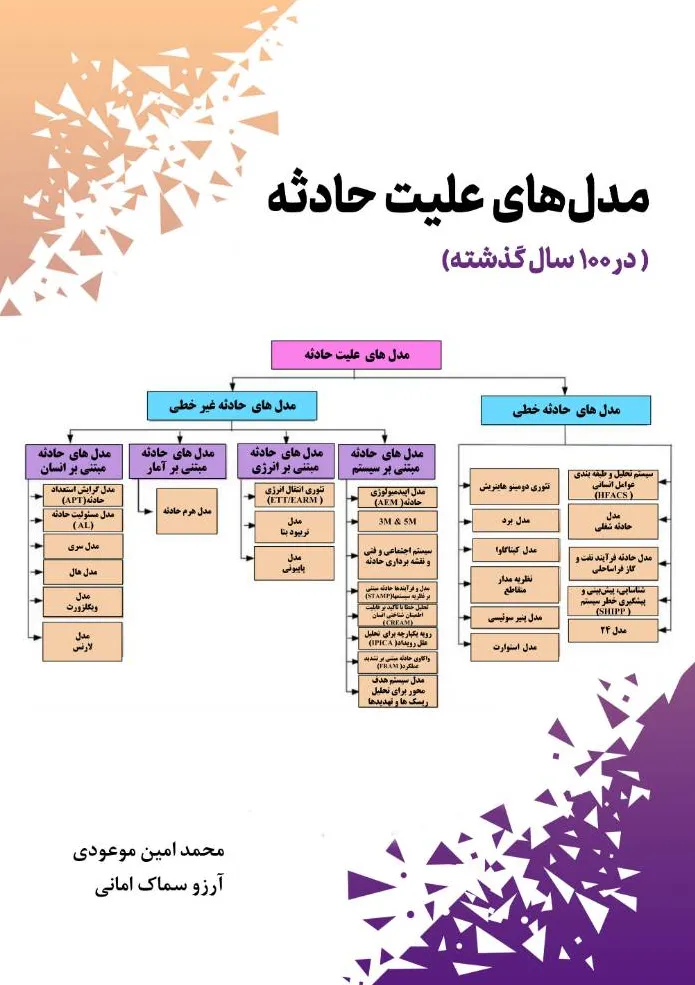
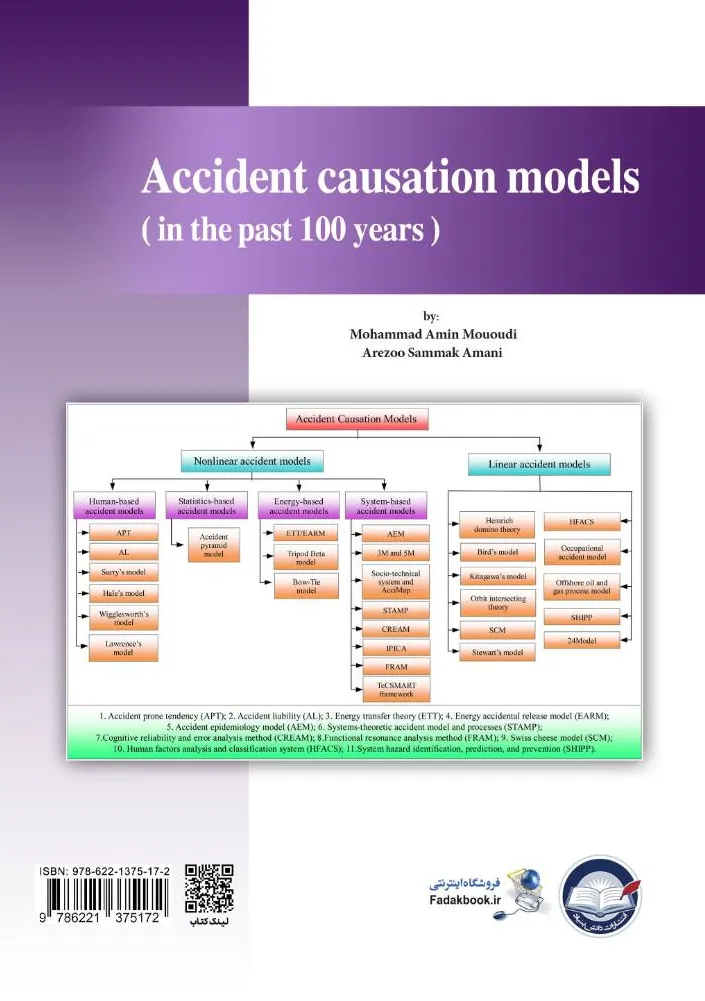
هدف علم ایمنی جلوگیری از حوادث است. با این حال، بهبود ایمنی سیستمها از طریق کاهش حوادث همچنان چالش برای دانشمندان ایمنی است (گرانت و همکاران ، 2018). مدلهای علیت حادثه، به شفافسازی علت، فرآیند و عواقب حوادث کمک میکنند و تحلیلی دقیق از وقوع و توسعه آنها ارائه میدهند. با استفاده از مدل علیت حادثه برای تحلیل حادثه، میتوان بهراحتی علل مختلف حادثه و نقاط ضعف کاستیها2 در فرآیند تولید را شناسایی کرد (علی و همکاران3، 2014). این امر در اجرای مسئولیت پس از حادثه و پیشگیری از حوادث آینده نقش حیاتی دارد. بهعنوان مهمترین مبانی نظری و روش تحقیق در علم ایمنی، لازم است تاریخچۀ توسعۀ مدلهای علیتی حادثه بهطور واضح و روشن تفسیر و شرح داده شود.
در دوران باستان، سطح تحصیلات نسبتاً ابتدایی بود و مردم وقوع حوادث را خواست خدا میدانستند.از ابتدای دوران انقلاب صنعتی، تولیدات انسانی دستخوش تغییرات عمدهای شده و نرخ مرگ و میر کارگران به میزان چشمگیری افزایشیافته است و به جبران خسارت (غرامت) کارگران برای صدمات جسمانی ناشی از کار منجر شده است. برای حل تعارض میان کارفرمایان و کارمندان در مسئلۀ جبران خسارت، بهتدریج سیستمهای حقوقی خاصی در مورد جبران خسارت کارگران بوجود آمده است. بهعنوانمثال، در سال ۱۹۰۸ ایالت نیویورک قانون جبران خسارت کارگران را تصویب کرد (اپشتین4 ،1981). پس از آن، ایالاتمتحده "جنبش ایمنی" معروف را راهاندازی کرد و مردم شروع به مطالعه علل حوادث و چگونگی پیشگیری از آنها کردند (فو5، 2013). در سال 1919، گرینوود و وودز6 (1919) گرایش مستعد حادثه را پیشنهاد کردند، که اولین مدل علیت حادثه در تاریخ بشر شد. سال 2019 نشان از گذراندن 100 سال مطالعه درباره مدلهای علیت حادثه است.
در قرن گذشته، تجربیات بسیاری دربارۀ صدمات جسمانی و حوادث جمعآوری شده، و علل و قوانین پیشگیری از حوادث مورد بررسی قرارگرفته است. بر این اساس، در مورد چرایی و چگونگی وقوع حوادث و روشهای پیشگیری از آنها، تفکر و تحقیق زیادی انجامشده است و دیدگاهها و مدلهای متعددی پیشنهادشده است. مدلهای اولیه علیت حوادث عمدتاً مربوط به عوامل انسانی در حوادث است. مدلهای نماینده شامل مدلهای گرایش مستعد حادثه (گرین وود و وودز، 1919)، مسئولیت حادثه (مینتز و بلوم ، 1949) و مدل سری (سری2، 1969) هستند.
پس از آن، تمرکز پیشگیری از حوادث به سمت انرژی، یعنی نحوه جلوگیری از آزادسازی و انتقال انرژی، سوق پیدا کرد.
مدلهای نماینده3 شامل تئوری انتقال انرژی هادون4 (1968)، مدل تری پود بتا5 و مدل پاپیون6 (استمن و همکاران7 ، 2018؛ کلوتیه و همکاران8، 2018؛ کرومیر و همکاران9، 2019) هستند.
در سالهای اخیر، تمرکز مدلهای علیت حوادث بر مدلهای سازمان یافته10 مانند AcciMap ((راسموسن11 ، 1997; سامو و همکاران12، 2017; گنکالوز و همکاران13، 2019))، CREAM ((هولناگل14،1998 ; آنگ15 ،2019)) ، STAMP ((لوسون16، 2004; استنتون و همکاران17، 2019))، FRAM ((هولناگل، 2012; ابوذر و همکاران18، 2018)) تغییر کرده است. این مدلها بهخاطر تحلیل عمیقتر علل حوادث و وجود روابط منطقی واضحتر محبوبیت بیشتری پیدا کردهاند. از زمان ارائه نظریه دومینو توسط هاینریش19 (1931)، مدل علیت حادثه خطی بهدلیل دستهبندی واضح علل حادثه به خوبی مورد استقبال قرار گرفته است.
پس از آن، مدل پنیر سوئیسی20 (ریزون21، 1990، 1997، 2008؛ هولناگل، 2004) و HFACS (شاپل و ویگمن22، 2001، 2003، 2004) نیز بهطور گستردهای مورد استقبال قرار گرفتند. اگرچه مدلهای علیت حادثه در دورههای مختلف تفاوت دارند، اما همگی نقش مهمی در کاهش حوادث دارند. در توسعه مدلهای علیت حادثه، هنوز چالش های زیادی وجود دارد که باید حل شود.
1- مطالعات مروری درمورد توسعه مدلهای علیت حادثه بسیار اندک است. اگرچه برخی از پژوهشگران مدلهای علیت حادثه را معرفی کردهاند (قریشی23، 2007؛ علی و همکاران، 2014؛ لیت همکاران ، 2017؛ پاسمان و همکاران2، 2018) ، اما این معرفیها سازمان یافته نبوده است. برخی از مدلهای علیت حادثه کلاسیک بهدلیل سابقه طولانی خود بهتدریج ناپدید شدهاند و این امر به فقدان مطالعات سازمان یافته و جامع در این حوزه منجر شده است. بنابراین، بررسی سازمان یافته مدلهای علیت حادثه در 100 سال گذشته ضروری است.
2- معرفیهای کمی دربارۀ شرایط کاربرد مدلهای علیت حادثه وجود دارد. هر مدل علی حادثه در یک زمینه و با تاریخ خاص خود تنظیم و طراحی شده و مزایا و معایب خاص خود را دارد. استفاده از مدل علیت حادثه مستلزم آشنایی با شرایط کاربردی مدل است. برخی از مدلهای کلاسیک حادثه، مانند مدل پنیر سوئیسی و HFACS، بهطور گستردهای شناختهشده و مورد استفاده قرارگرفتهاند. اما برخی مدلهای قدیمیتر مانند مدل برد (برد و جرمین3، 1966، 1996؛ کوجث و همکاران4، 2010)، مدل هال ((هال و هال5 ، 1970)) و مدل لارنس (لارنس6، 1974) بهخوبی شناخته نشدهاند. این مدلها ویژگیهای کاربردی خاص خود را دارند که باید برای استفاده از آنها با آنها آشنا شد.
3- معرفیهای کافی برای مدلهای جدید علیت حادثه وجود ندارد. باگذشت زمان، مدلهای علیت حادثه همچنان در حال توسعه هستند. آخرین مدلهای علیت حادثه از دیدگاه نظری کاملتر هستند و از مزایای آنالیز و پیشگیری از حادثه برخوردار هستند. چندین مدل جدید، بهویژه آنهایی که نوآوریهای نظری دارند، مانند مدل استوارت (استوارت7، 2001)، مدل حادثه شغلی (آتوود و همکاران8، a,b,c2006)، مدل فرآیند نفت و گاز فراساحلی (کوجث و همکاران، 2010)) SHIPP ((راسنیاکا و همکاران9 ، a,b2011))، چارچوب TeCSMART ((ونکاتاسوبرامانیان و ژانگ10، 2016))، مدل 24 ((فو و همکاران11، 2018، 2019)) نیاز به معرفی دارند.
4- در مورد اینکه چگونه مدلهای علیت حادثه در تقویت پیشگیری از حوادث مؤثرتر هستند، با فقدان تفکر عمیق روبرو هستیم.
راثنایاکا از تحلیل کیفی (گنکالوز و همکاران، 2019؛ استنتون و همکاران، 2019) تا تحلیل کمی (آنگ، 2019؛ هان و همکاران ، 2019) و تحلیل های پویا (خاکزاد و همکاران2، a2012 ،b2012 ،2013؛ زارعی و همکاران3، 2017)، مدل های علیت حادثه به تدریج در خدمات خود به علم ایمنی بهبود مییابند. در عصر هوش مصنوعی و دادههای کلان4، استفاده از مدلهای علیت حادثه برای پیشگیری عمیقتر از حوادث نیز یکی از حوزههای فعال تحقیقات علمی ایمنی خواهد بود.
بهطور خلاصه، برای جلوگیری از حوادث بهطور مؤثرتر، لازم است تاریخچه مدلهای علیت حادثه ایجاد شده در 100 سال گذشته، بهویژه مدلهای خاص کلاسیک و ابتکاری نظری، روشن شود. پیشینه، تاریخچه توسعه، جریان کاربرد و وضعیت کاربرد این مدلها بهطور کامل شرح دادهشده است. علاوه بر این، روند توسعه و روند کاربرد آنها مورد بحث قرارگرفته است. امید است که این بررسی به توسعه مدلهای علیت حادثه کمک کرده و به نتایج بهتر در پیشبینی و پیشگیری از حوادث کمک کند.
هدف و پاداش برگردانندگان و دیگر کسانی که از آغاز تا پایان درگیر بودهاند، بیشتر از هرچیز امید به خوشنودی پروردگار متعال و همراه و همگام شدن دیگر عزیزانی است که میخواهند گرهای از مشکلات این جامعه بگشایند. آنچه شده، آغاز است و آنچه باید بشود کرانهای در دوردستها دارد.
تقاضامنديم دانشمندان و علاقهمندان، نکات و نظریات ارشادی خویش را در جهت رفع اشکالات اعلام نمایند.
محمد امین موعودی
Mououdi 2006@ yahoo.com
آرزو سماک امانی
Arezoo.sam 76@ yahoo.com
فهرست
پیشگفتار الف
مدلهای علیت حادثه (Accident Causation Model) 2
طبقهبندی مدلهای علیت حادثه 3
مدلهای خطی 3
مدلهای خطی پيچيده (complex linear) 4
مدلهای علیت حادثه مبتنی بر انسان 5
مدل علیت حادثه مبتنی بر آمار 13
مدل هرم حادثه 13
مدل علیت حادثه مبتنی بر انرژی 16
مدل تریپودبتا (Tripod beta) 22
مدل پاپیون 27
مدلهای علیت حادثه مبتنی بر سیستم 34
مدل اپیدمیولوژی حادثه 34
مدل 3M 35
مدل 5M 35
مدل سیستم فنی- اجتماعی و نقشهبرداری حادثه 37
روش تجزیه و تحلیل خطا با تاکید بر قابلیت اطمینان شناختی انسان (CREAM) 39
مدل و فرآيندهای حادثه مبتنی بر نظریه سیستمها (STAMP) 47
رویه یکپارچه برای تجزیهوتحلیل علل رویداد(IPICA) 51
روش واكاوي حادثه مبتني بر تشديد عملكرد (FRAM) 53
مدل TeCSMART (مدل سیستم هدف محور برای تحلیل ریسکها و تهدیدها) 57
مدلهای علیت خطی 59
سیستم آناليز و طبقهبندی فاکتورهای انسانی (HFACS) 61
مدل علیت حادثه بِرد 63
مدل علیت حادثه کیتاگاوا 64
نظریه مدار متقاطع (OIT) 65
تئوري دومينو هاینریش (1931) 67
مدل پنير سوئيسي (SCM) 71
مدل عليت حادثه استوارت 75
مدل حادثه شغلی (OAC) 77
مدل حادثه فرآیند نفت و گاز فراساحلی (OOGM) 80
شناسايي، پيشبيني و پيشگيري خطر سيستم (SHIPP) 81
24Model 85
مقایسه مدلهای حادثه 90
پیوست (روشهای کنترل ایمنی رفتاری) 97
B-Safe 98
فلسفه B-Safe: 98
فرایند B-Safe 98
توقف به منظور حفظ ایمنی (TOFS) 98
ممیزی ایمنی پیشرفته (ASA) 99
برنامه آموزش و مشاهدات ایمنی (STOP) 101
کارت STOP 103
منابع
1- Abdo, H., Kaouk, M., Kaouk, J.M., et al., 2018. A safety/safety risk analysis approach of industrial control systems: a cyber bowtie -combining new version of attack tree with bowtie analysis. Computers & safety 72, 175–195.
2- Abouzar, Yousefi, Hernandez, Manuel Rodriguez, Pe˜na, Valentin Lopez, 2018. Systemic Accident Analysis Models: a Comparison Study between AcciMap, FRAM, and STAMP. Process Safety Progress. 38, No.2.
3- Adelstein, A.M., 1952. Accident-proneness: a criticism of the concept based upon an analysis of shuntee’s accidents. J. Royal Stat. Society 115 (3), 354–410.
4- Adrián, Morales-Torres, Escuder-Bueno, Ignacio, Serrano-Lombillo, Armando, et al.,2019. Dealing with epistemic uncertainty in risk-informed decision making for dam safety management. Reliab. Eng. Syst. Saf. 191, 106562.
5- Akyuz, Emre, Celik, Metin, 2015. Application of CREAM human reliability model to cargo loading process of LPG tankers. J. Loss Prev. Process Ind. 34, 39–48.
6- Albery, Simon, David, Borys, Susanne, Tepe, 2016. Advantages for risk assessment: evaluating learnings from question sets inspired by the FRAM and the risk matrix in a manufacturing environment. Saf. Sci. 89, 180–189.
7- Alexander, Tiffaney Miller, 2019. A case based human reliability assessment using HFACS for complex space operations. J. Space Saf. Eng. 6, 53–59.
8- Ali, Al-shanini, Ahmad, Arshad, Khan, Faisal, 2014. Accident modelling and analysis in process industries. J. Loss Prev. Process Ind. 32, 319–334.
9- Allison, Craig K., Revell Kirsten, M., Rod, Sears, et al., 2017. Systems Theoretic Accident Model and process (STAMP) safety modelling applied to an aircraft rapid decompression event. Saf. Sci. 98, 159–166.
10- Anbari, Mohammad Javad, Massoud, Tabesh, Abbas, Roozbahani, 2017. Risk assessment model to prioritize sewer pipes inspection in wastewater collection networks. J. Environ. Manage. 190, 91–101.
11- Anderson, J.R., 1987. Methodologies for studying human knowledge. Behavioural and Brain Sciences 10 (3), 467–505.
12- Anvarifar, Fatemeh, Voorendt Mark, Z., Chris, Zevenbergen, et al., 2017. An application of the Functional Resonance Analysis Method (FRAM) to risk analysis of multifunctional flood defences in the Netherlands. Reliab. Eng. Syst. Saf. 158,130–141.
13- Aqlan, F., Mustafa Ali, E., 2014. Integrating lean principles and fuzzy bow-tie analysis for risk assessment in chemical industry. J. Loss Prev. Process Ind. 29, 39–48.
14- Arbous, A.G., Kerrich, J.E., 1951. Accident statistics and the concept of accident-proneness. Biometrics. 7 (4), 340–432.
15- Arnold, Barnett, Wang, Alexander, 2000. Passenger mortality risk estimates provide perspectives about flight safety. Flight Saf. Dig. 19 (4), 1–12.
16- Ashby, W.R., 1956. An Introduction to Cybernetics. Chapman and Hall, London.
17- Attwood, D., Khan, F., Veitch, B., 2006a. CAN WE PREDICT OCCUPATIONAL ACCIDENTFREQUENCY? Process. Saf. Environ. Prot. 84, 208–221.
18- Attwood, Daryl, Khan, Faisal, Veitch, Brian, 2006b. Offshore oil and gas occupational accidents—What is important? J. Loss Prev. Process Ind. 19, 386–398.
19- Attwood, Daryl, Khan, Faisal, Veitch, Brian, 2006c. Occupational accident models—Where have we been and where are we going? J. Loss Prev. Process Ind. 19, 664–682.
20- Aven, T., Sklet, S., Vinnem, J.E., 2006. Barrier and operational risk analysis of hydro-carbon releases. (BORA-Release) Part I. Method description. J. Hazard. Mater.A137, 681–691.
21- Badreddine, A., Amor, N.B., 2013. A Bayesian approach to construct bow tie diagrams for risk evaluation. Process. Saf. Environ. Prot. 91, 159–171.
22- Baumann, Florian, Friehe, Tim, 2016. Learning-by-doing in torts: liability and information about accident technology. Econ. Lett. 138, 1–4.
23- Bird, F.E., Germain, G.L., 1966. Damage Control: A New Horizon in Accident Prevention and Cost Improvement. American Management Association, New York.
24- Bird, F.E., Germain, G.L., 1996. Practical Loss Control Leadership. Det Norske Veritas(USA), Georgia.
25- Bird, F.E., Loftus, R.G. (Eds.), 1976. Loss Control Management. Institute Press (Division of International Loss Control Institute). Bjerga Torbjørn, Aven Terje, ZioEnrico, 2016. Uncertainty treatment in risk analysis of complex systems: The cases of STAMP and FRAM. Reliability Engineering and System Safety, Loganville,Georgia, 156, 203-209.
26- Bot, P.L., 2004. Human reliability data, human error and accident models—illustration through the Three Mile Island accident analysis. Reliab.Eng. Syst. Saf. 83, 153–167.
27- Bronfenbrenner, U., 1979. The Ecology of Human Development. Harvard University Press, Cambridge, MA.
28- Brown, K.A., Willis, P.G., Prussia, G.E., 2000. Predicting safe employee behavior in the steel industry: development and test of a sociotechnical model. J. Oper.Manag. 18, 445–465.
29- Cheyne, A., Tomas, J.M., Cox, S., et al., 1999. Modelling employee attitudes to safety: a comparison across sectors. Eur. Psychol. 4 (1).
30- Clothier, R.A., Williams, B.P., Hayhurst, K.J., 2018. Modelling the risks remotely piloted aircraft pose to people on the ground. Saf. Sci. 101, 33–47.
31- Cobb, P.W., 1940. The limit of usefulness of accident rate as a measure of accident proneness. J. Appl. Psychol. 24 (2), 154–159.
32- Cormier, Roland, Elliott, Michael, Rice, Jake, 2019. Putting on a bow-tie to sort out who does what and why in the complex arena of marine policy and management. Sci. Total Environ. 648, 293–305.
33- Cormier, Roland, Stelzenmüller, Vanessa, Creed Irena, F., et al., 2018. The science-policy interface of risk-based freshwater and marine management systems: from concepts to practical tools. J. Environ. Manage. 226 (15), 340–346.
34- Creswell, W.L., Froggart, P., 1963. The Causadon of Bus Driver Accidents-An Epidemiological Study. Oxford University Press, London.
35- Damme Katherine, S.F., Natalie, Gallagher, Teresa, Vargas, et al., 2019. Motor sequence learning and pattern recognition in youth at clinical high-risk for psychosis. Schizophr. Res. 208, 454–456.
36- Daramola, Adebukola Yewande, 2014. An investigation of air accidents in Nigeriausing the Human Factors Analysis and Classification System (HFACS) frame work.J. Air Transp. Manag. 35, 39–50.
37- Day, Andrea J., Brasher, Kate, Bridger, Robert S., 2012. Accident proneness revisited: the role of psychological stress and cognitive failure. Accid. Anal. Prev. 49,532–535.
38- Debrincat, Justin, Bil, Cees, Clark, Graham, 2013. Assessing organisational factors in aircraft accidents using a hybrid Reason and AcciMap model. Eng. Fail. Anal. 27,52–60.
39- Dianous, D.V., Fievez, C., 2006. ARAMIS project: a more explicit demonstration of risk control through the use of bow-tie diagrams and the evaluation of safety barrier performance. J. Hazard. Mater. 130, 220–233.
40- Dien, Y., Dechy, N., Guillaume, E., 2012. Accident investigation: From searching direct causes to finding in-depth causes—Problem of analysis or/and of analyst? Saf. Sci. 50 (6), 1398–1407.
41- Doran, J.A., Graaf, V.D., et al., 1996. Tripod-BETA : Incident Investigation and Analysis. Tripod-BETA: Incident Investigation and Analysis.
42- EI Tripod Beta, 2014. Tripod Beta: Guidance On Using Tripod Beta In The Investigation And Analysis Of Incidents, ed. 1. Accidents.
43- Embrey, D.E., 1992. Incorporating management and organisational factor into probabilistic safety assessment. Reliab. Eng. Syst. Saf. 38, 199–208.
44- Epstein, Richard A., 1981. The Historical Origins and Economic Structure of Workers’ Compensation Law. 16 Georgia Law Review 775 https://chicagounbound.uchicago.edu/cgi/viewcontent.cgi?article=2237&context=journal articles.
45- Ergai, Awatef, Cohen, Tara, Sharp, Julia, et al., 2016. Assessment of the human factors analysis and classification system (HFACS): intra-rater and inter-rater reliability. Saf. Sci. 82, 393–398.
46- Farmer, E., Chambers, E.G., 1929. A Study of Personal Qualities in Accident Proneness and Proficiency. Report no. 55. Industrial Health Research Board Report H.M.S.O.,London.
47- Ferjencik, Milos, 2011. An integrated approach to the analysis of incident causes.Saf. Sci. 49, 886–905.
48- Ferjencik, Milos, 2012. An integrated approach to the analysis of causes of crime/public disorder—a case study for the “Tlahuac” incident. Reliab. Eng. Syst.Saf. 105, 13–24.
49- Ferjencik, Milos, 2014. IPICA Lite—improvements to root cause analysis. Reliab. Eng.Syst. Saf. 131, 1–13.
50- Goncalves, Filho Anastacio Pinto, Jun, Gyuchan Thomas, Waterson, Patrick, 2019.Four studies, two methods, one accident –an examination of the reliability and validity of Accimap and STAMP for accident analysis. Saf. Sci. 113, 310–317.
51- Fu, Gui, 2013. Safety Management: A Behavior-Based Approach to Accident Prevention, first ed. Science Press, Beijing.
52- Fu, Gui, Cao, Jia-Lin, Zhou, Lin, et al., 2017a. Comparative study of HFACS and the24Model accident causation models. Pertoleum Science. 14, 570–578.
53- Fu, G., Fan, Y., Tong, R., et al., 2017b. A universal method for the causation analysisof accidents (version 4.0). J. Accid. Prev. 3, 1–7.
54- Fu, G., Wang, J.H., Yan, M.W., 2016. Anatomy of Tianjin Port fire and explosion: process and causes. Process Saf Prog. 35, 216–220.
55- Fu, Gui, Lu, Bai, Chen, Xiuzhen, 2005. Behavior based model for organizational safety management. China Safety Science Journal. 15 (9), 21–27.
56- Fu, Gui, Yang, Chun, Yin, Wen-tao, et al., 2014. Extended version of behavior-based accident causation “2-4” model. Journal of China Coal Society. 39, 994–999.
57- Fu, G., Yin, W., Dong, J., Di, F., Zhu, C.J., 2013. Behavior-based accident causation: the“2-4” model and its safety implications in coal mines. J. China Coal Soc. 38 (7),1123–1129.
58- Fu, Gui, Zhao Ziqi, Zhao, Hao, Chuanbo, et al., 2019. The accident path of coal mine gas explosion based on 24Model: a case study of the ruizhiyuan gas explosion accident. Processes 7 (73).
59- Fu, Gui, Zhou, Lin, Wang, Jianhao, et al., 2018. Analysis of an explosion accident at Dangyang Power Plant in Hubei, China: causes and lessons learned. Saf. Sci. 102,134–143.
60- Geyer, T.A.W., Bellamy, L.J., 1991. Pipework Failure, Failure Causes and the Management Factor. The Institute of Mechanical Engineers., London.
61- Gibson, J.J., 1964. The contribution of experimental psychology to the formulation of the problem of safety—a brief for basic research. In: Haddon, W., Such man, E.A.,Klein, D. (Eds.), Accident Research: Methods and Approaches. Harper & Row,New York, NY.
62- Gielen, A.C., Sleet, D., 2003. Application of behavior-change theories and methods to injury prevention. Epidemiol. Rev. 25, 65–76.
63- Grant, Eryn, Salmon Paul, M., Stevens Nicholas, J., et al., 2018. Back to the future: What do accident causation models tell us about accident prediction? Saf. Sci.104, 99–109.
64- Green, J., 1991. Accident proneness [3]. J. R. Soc. Med. 84 (8), 510–1510.Gong, Yunhua, Li, Yuntao, 2018. STAMP-based causal analysis of China-Donghuangoil transportation pipeline leakage and explosion accident. J. Loss Prev. ProcessI nd. 56, 402–413.
65- Gordon, J.E., 1949. The epidemiology of accidents. Am. J. Public Health Nations Health39 (4), 504–515.
66- Greenwood, M., Woods, H.M., 1919. The Incidence of Industrial Accidents Upon Individuals With Special Reference to Multiple Accidents. Report no. 4. Industrial Fatigue Research Board, London.
67- Guo, C., Khan, F., Imtiaz, S., 2018. Risk assessment of process system considering dependencies. J. Loss Prev. Process Ind. 55, 204–212.
68- Haddon, W., Suchman, E.A., Klein, D., 1964. Accident Research: Methods and Approaches. Harper & Row, New York, NY.
69- Haddon, W., 1968. The changing approach to the epidemiology, prevention, and amelioration of trauma: the transition to approaches etiologically rather than descriptively based. Am. J. Public Health Nations Health 58 (8), 1431–1438.
70- Haddon, W., 1972. A logical framework for categorizing highway safety phenomena and activity. J. Trauma 12, 193–207.
71- Haddon, W., 1973. Energy damage and the ten countermeasure strategies. J. Trauma13 (4), 321–331.
72- Haddon, W., 1980a. Advances in the epidemiology of injuries as a basis for public policy. Public Health Rep. 95, 411–421.
73- Haddon, W., 1980b. Options for the prevention of motor vehicle crash injury. Isr. J.Med. Sci. 16, 45–68.
74- Haghighattalab, Sakineh, Chen, An, Fan, Yunxiao, et al., 2019. Engineering ethics within accident analysis models. Accid. Anal. Prev. 129, 119–125.
75- Haight, F.A., 2001. Accident Proneness: The History of an Idea, UCI-ITS-WP-01-4.Institute of Transportation Studies, University of California.
76- Irvine Hajj, C.E., Piatyszek, E., Tardy, A., et al., 2015. Development of generic bow-tie diagrams of accidental scenarios triggered by flooding of industrial facilities (Natech). J. Loss Prev. Process Ind. 36, 72–83.
77- Hale, A.R., 2002. Conditions of occurrence of major and minor accidents: Urban myths, deviations and accident scenarios. Tijdschrift Voor Toegepaste Arbowetenschap 15 (3), Delft http://www.arbeidshygiene.nl/-uploads/files/insite/2002-03-hale-full-safety-trf.pdf.
78- Hale, A.R., Hale, M., 1970. Accidents in perspective. Occup. Psychol. 44, 115–122.
79- Hale, Andrew, 2001. Conditions of occurrence of major and minor accidents. Institution of Occupational Safety and Health. IOSH Journal 5 (1), 7–21.
80- Hale, A., Ale, B., Bellamy, L., et al., 2005. Best practice in risk assessment: work accidents. In: European Consumer Safety Association Conference, Edinburgh, 20-21April, 2005.
81- Han, Xiao, Tang, Tao, Lv, Jidong, 2019. A hierarchical verification approach to verify complex safety control systems based on STAMP. Sci. Comput. Program. 172,117–134.
82- He, Xuhong, Wang, Yao, Shen, Zupei, 2008. A simplified CREAM prospective quantification process and its application. Reliab. Eng. Syst. Saf. 93, 298–306.
83- Heinrich, Herbert William, 1931. Industrial Accident Prevention: a Scientific Approach. McGraw-Hill, New York, NY, US.
84- Herrera, I.A., Woltjer, R., 2010. Comparing a multi-linear (STEP) and systemic (FRAM) method for accident analysis. Reliability Engineering and System Safety. 95,1269–1275.
85- Hollnagel, E., Embrey, D.E., 1993. Human reliabilty analysis in safety assessment: adressing cognitive and action errors. In: IBC Conference on PSA/PRA for the Nuclear Industry, November 1-2, London.
86- Hollnagel, E., Marsden, P., 1995. Further Development of the Phenotype-genotype Classification Scheme for the Analysis of Human Erroneous Actions. HRA Ltd.,Dalton, UK.
87- Hollnagel, E., 1998. Cognitive Reliability and Error Analysis Method. CREAM. Elsevier, Amsterdam, ISBN-13: 978-0080428482 and ISBN-10: 0080428487.Hollnagel, E., 2004. Barriers and Accident Prevention. Ashgate., Aldershot, UK.
88- Hollnagel, E., 2012. FRAM: the Functional Resonance Analysis Method: Modelling Complex Socio-technical Systems. Ashgate Publishing Ltd, Farnham, Surrey, U.K,ISBN-13: 978–1409445517 and ISBN-10: 1409445518.
89- Hoss, F., Jonkman, S.N., Maaskant, B., 2013. A comprehensive assessment of multi-layered safety in flood risk management-the Dordrecht case study. Floods: from Risk to Opportunity, vol. 357. IAHS Publ.
90- Hoss, F., Klima, K., Fischbeck, P., 2014. Ten strategies to systematically exploit all options to cope with anthropogenic climate change. Environ. Syst. Decis. 34,578–590.
91- Houston, D.E.L., 1971. New Approaches to the Safety Problem. Major Loss Prevention.
92- Huang, Wencheng, Shuai, Bin, Zuo, Borui, et al., 2019. A systematic railway dangerous goods transportation system risk analysis approach: the 24Model. J. Loss Prev. Process Ind. 61, 94–103.
93- Hudson, P.T.W., Groeneweg, J., Reason, J.T., Wagenaar, W.A., Van der Meeren, R.J.W.,Visser, J.P., 1991. Application of tripod to measure latent errors in North Sea gas platforms: validity of failure state profiles. In: First Int’l Conf. On Health, Safety and Environment. Soc. Petr. Eng., The Hague, NL, pp. 725–730, 10-14 November.
94- Hudson, P.T.W., Reason, J.T., Wagenaar, W.A., Bentley, P.D., Primrose, M., Visser,J.P., 1994. Tripod-delta: a proactive approach to enhanced safety. Journal of Petroleum Technology, SPE 27846, 1–9.
95- Hurst, N.W., 1998. Risk Assessment—The Human Dimension. The Royal Society of Chemistry.
96- Jacinto, Celeste, Silva, Cristina, 2010. A semi-quantitative assessment of occupational risks using bow-tie representation. Saf. Sci. 48, 973–979.
97- Johnson, W.G., New York 1980. MORT Safety Assurance Systems. Kanes, R., Marengo, M.C.R., Abdel-Moati, H., et al., 2017. Developing a framework for dynamic risk assessment using Bayesian networks and reliability data. J. Loss Prev. Process Ind. 50, 142–153.
98- Karanikas, Nektarios, Melis, Damien Jose, Kourousis Kyriakos, I., 2018. The balance between safety and productivity and its relationship with human factors and safety awareness and communication in aircraft manufacturing. Saf. Health Work 9, 257–264.
99- Karin van, Thienen-Visser, Hendriks, Dimmie, Marsman, Annemieke, et al., 2014.Bow-tie risk assessment combining causes and effects applied to gas oil storage in an abandoned salt cavern. Eng. Geol. 168, 149–166.
100- Khakzad, N., Khan, F., Amyotte, P., 2012a. Dynamic risk analysis using bow-tie approach. Reliab. Eng. Syst. Saf. 104, 36–44.
101- Khan, F., Rathnayaka, S., Ahmed, S., 2015. Methods and models in process safety and risk management: past, present and future. Process. Saf. Environ. Prot. 98,116–147.
102- Kjellen, U., Sklett, S., 1995. Integrating analyses of the risk of occupational accidents into the design process. Part I: a review of types of accident criteria and risk analysis methods. Saf. Sci. 18, 215–227.
103- Khakzad, Nima, Khan, Faisal, Amyotte, Paul, 2012b. Dynamic risk analysis using bow-tie approach. Reliab. Eng. Syst. Saf. 104, 36–44.
104- Khakzad, Nima, Khan, Faisal, Amyotte, Paul, 2013. Dynamic safety analysis of process systems by mapping bow-tie into Bayesian network. Process. Saf. Environ. Prot.91, 46–53.
105- Kogevinas, M., 1998. The loss of the population approach puts epidemiology at risk. J. Epidemiol. Community Health 52, 615–616.
106- Krause, Thomas R., 1997. The Behavior Based Safety Process. Van Nostrand Reinhold Company, New York.
107- Kreiger, N., 1994. Epidemiology and the web of causation: has anyone seen the spider? Soc. Sci. Med. 39, 887–903.
108- Kreiger, N., 2001. Theories for social epidemiology in the 21st century: an ecosocial perspective. Int. J. Epidemiol. 30, 668–677.
109- Kujath, M.F., Amyotte, P.R., Khan, F.I., 2010. A conceptual offshore oil and gas process accident model. J. Loss Prev. Process Ind. 23, 323–330.
110- Kune, J.B., 1985. Accident liability. Br. J. Ind. Med. 42, 336–340.
111- Kurowicka, D., Cooke, R., Goossens, L., Ale, B., 2006. Expert judgment study for placement ladder bow-tie. In: Guedes Soares, Zio (Ed.), Safety and Reliability for Managing Risk, Vol. 1. ESREL 2006. Balkema, Taylor & Francis Group, London,pp. 21–27.
112- Lardner, Ronny, Hale, A.R., Hale, M., 2005. Accidents in perspective. Policy Pract. Health Saf. 3, 5–12.
113- Lawrence, A.C., 1974. Human error as a cause of accidents in gold mining. J. Safety Res. 6 (2), 78–88.
114- Lee, Joohee, Chung, Hyun, 2018. A new methodology for accident analysis with human and system interaction based on FRAM: case studies in maritime domain.Saf. Sci. 109, 57–66.
115- Leveson, N., 2004. A new accident model for engineering safer systems. Saf. Sci. 42,237–270.
116- Leveson, N., 2011. Engineering a Safer World, Systems Thinking Applied to Safety. The MIT Press, pp. 60 ISBN-10:0–262-01662-1 ISBN-13:978-0-262-01662-9.
117- Leveson, N.G., 2015. A systems approach to risk management through leading safetyindicators. Reliab. Eng. Syst. Saf. 136, 17–34.
118- Li, Chenling, Tang, Tao, Chatzimichailidou, M.M., et al., 2019a. A hybrid human and organisational analysis method for railway accidents based on STAMP-HFACS and human information processing. Appl. Ergon. 79, 122–142.
119- Li, Weijun, He, Min, Sun, Yibo, et al., 2019b. A proactive operational risk identification and analysis framework based on the integration of ACAT and FRAM. Reliab. Eng.Syst. Saf. 186, 101–109.
120- Li, Weijun, Zhang, Laibin, Liang, Wei, 2017. An Accident Causation Analysis and Taxonomy (ACAT) model of complex industrial system from both system safety and control theory perspectives. Saf. Sci. 92, 94–103.
121- Liu, Jing, Liu, Renzhi, Zhang, Zhijiao, et al., 2019a. A Bayesian Network-based risk dynamic simulation model for accidental water pollution discharge of mine tailings ponds at watershed-scale. J. Environ. Manage. 246, 821–831.
122- Liu, Rulin, Cheng, Weimin, Yu, Yanbin, et al., 2019b. An impacting factors analysis of miners’unsafe acts based on HFACS-CM and SEM. Process. Saf. Environ. Prot.122, 221–231.
123- Liu, X., Li, J., Li, X., 2017. Study of dynamic risk management system for flammable and explosive dangerous chemicals storage area. J. Loss Prev. Process Ind. 49,983–988.Long, S., Dhillon, B.S., 2015. Proceedings of the 13th International Conference on Man-Machine-Environment System Engineering , Springer, Berlin Heidelberg.
124- Lu, Linlin, Liang, Wei, Zhang, Laibin, et al., 2015. A comprehensive risk evaluation method for natural gas pipelines by combining a risk matrix with a bow-tie model. J. Nat. Gas Sci. Eng. 25, 124–133.
125- Mackie, Tom, 2018. Proving liability for highly and fully automated vehicle accidents in Australia. Computer Law & safety Review. 34, 1314–1332.
126- Mage, L., Baati, N., Nanchen, A., et al., 2017. A systematic approach for thermal stability predictions of chemicals and their risk assessment: pattern recognition and compounds classification based on thermal decomposition curves. Process. Saf. Environ. Prot. 110, 43–54.
127- Marius, Vileiniskis, Rasa, Remenyte-Prescott, 2017. Quantitative risk prognostics framework based on Petri Net and Bow-Tie models. Reliab. Eng. Syst. Saf. 165,62–73.
128- Markowski, Adam S., Kotynia, Agata, 2011. “Bow-tie” model in layer of protection analysis. Process. Saf. Environ. Prot. 89, 205–213.
129- Marshall, Pablo, Hirmas, Alejandro, Singer, Marcos, 2018. Heinrich’s pyramid and occupational safety: A statistical validation methodology. Saf. Sci. 101, 180–189.
130- McCauley-Bell, P., Badiru, A.B., 1996a. Fuzzy modelling and analytic hierarchy processing to quantify risk levels associated with occupational injuries-Part I: the development of fuzzy-linguistic risk levels. Ieee Trans. Fuzzy Syst. 4 (2).
131- McCauley-Bell, P., Badiru, A.B., 1996b. Fuzzy modelling and analytic hierarchy processing—means to quantify risk levels associated with occupational injuries—part II: the development of a fuzzy rule-based model for the prediction of injury. Ieee Trans. Fuzzy Syst. 4 (2).
132- McLeod, Ronald W., 2017. Human factors in barrier management: hard truths and challenges. Process. Saf. Environ. Prot. 110, 31–42.
133- McKenna, F.P., 1983. Accident proneness: a conceptual analysis. Accid. Anal. Prev.15 (1), 65–71.Meng, Xiangkun, Chen, Guoming, Shi, Jihao, et al., 2018. STAMP-based analysis of deep water well control safety. J. Loss Prev. Process Ind. 55, 41–52.
134- Mintz, A., Blum, M.L., 1949. A re-examination of the accident proneness concept. J.Appl. Psychol. 33, 195–211.
135- Mokhtari, K., Ren, J., Roberts, C., et al., 2011. Application of a generic bow-tie based risk analysis framework on risk management of sea ports and offshore terminals. J. Hazard. Mater. 192 (2), 465–475.
136- Munteanu, I., Aldemir, T., 2003. A methodology for probabilistic accident management. Nucl. Technol. 144.
137- Neal, A., Griffin, M.A., Hart, P.M., 2000. The impact of organizational climate on safety climate and individual behavior. Saf. Sci. 34 (1-3), 99–109.
138- Neeleman, J., 2001. A continuum of premature death. Meta-analysis of competing mortality in the psychosocially vulnerable. Int. J. Epidemiol. 30 (1), 154–162.
139- Neeleman, J., Wessely, S., Wadsworth, M., 1998. Predictors of suicide, accidental death and premature natural death in a general-population birth-cohort. Lancet351 (9096), 93–97.
140- Newbold, E.M., 1927. Practical application of the statistics of repeated events, particularly to industrial accidents. Journal of the Royal Statistical Society. 90, 487–535.
141- Osiris, A.Valdez Banda, Floris, Goerlandt, 2018. A STAMP-based approach for designing maritime safety management systems. Saf. Sci. 109, 109–129.
142- Pate-Cornell, M.E., Murphy, D.M., 1996. Human and management factors in probabilistic risk analysis: the SAM approach and observations from recent applications. Reliab. Eng. Syst. Saf. 53, 115–126.
143- Patriarca, Riccardo, Bergström, Johan, Di Gravio, Giulio, 2017a. Defining the functional resonance analysis space: combining Abstraction Hierarchy and FRAM. Reliab. Eng. Syst. Saf. 165, 34–46.
144- Patriarca, Riccardo, Di Gravio, Giulio, Costantino, Francesco, 2017b. The Functional Resonance Analysis Method for a systemic risk based environmental auditing in a sinter plant: a semi-quantitative approach. Environ. Impact Assess. Rev. 2017,72–86.
145- Pasman, Hans J., Rogers William, J., Sam, Mannan M., 2018. How can we improve process hazard identification? What can accident investigation methods con-tribute and what other recent developments? A brief historical survey and a sketch of how to advance. J. Loss Prev. Process Ind. 55, 80–106.
146- Pereira, Daniel Patrick, Hirata, Celso, Simin, Nadjm-Tehrani, 2019. A STAMP-based ontology approach to support safety and safety analyses. Journal of Information safety and Applications. 47, 302–319.
147- Froggatt, P., Smiley, J.A., 1964. The concept of accident proneness: a review. Br. J.Ind. Med. 21 (1), 1–12.
148- Pronko, N.H., 1980. Psychology From the Standpoint of an Interbehaviorist. Brooks/Cole Publishing Company, Monterey, CA.
149- Qiao, Wanguan, Li, Xinchun, Liu, Quanlong, 2019. Systemic approaches to incident analysis in coal mines: Comparison of the STAMP, FRAM and “2-4” models. Resour. Policy 63 (101453).
150- Qin, Rong, Peng, Dong-zhi, 2005. Discuss of the accident-causing theory. Journal of North China Institute of Science and Technology. 2 (3), 1–10.
151- Raben, Ditte Caroline, Viskum, Birgit, Mikkelsen, Kim L., et al., 2018. Application of a non-linear model to understand healthcare processes: using the functional resonance analysis method on a case study of the early detection of sepsis. Reliab.Eng. Syst. Saf. 177, 1–11.
152- Rasmussen, Jens, 1997. Risk Management in a dynamic society: a MODELLING PROB-LEM. Saf. Sci. 27 (2), 183–213.
153- Rasmussen, J., Svedung, I., 2000. Proactive Risk Management in a Dynamic Society, first ed. Swedish Rescue Services Agency, Karlstad, Sweden ISBN 91-7253-084-7. (The Swedish Rescue Services Agency is meanwhile renamed as Swedish CivilContingencies Agency (MSB)).
154- Rathnayaka, Samith, Khan, Faisal, Amyotte, Paul, 2011a. SHIPP methodology: predictive accident modeling approach. Part I: methodology and model description.Process. Saf. Environ. Prot. 89, 151–164.
155- Rathnayaka, Samith, Khan, Faisal, Amyotte, Paul, 2011b. SHIPP methodology: Predictive accident modeling approach. Part II. Validation with case study. Process. Saf. Environ. Prot. 89, 75–88.
156- Rawson, A., 1944. Accident proneness. Psychosom. Med. 6, 88–94.
157- Reason, J., 1990. Human Error. Cambridge University Press, Cambridge.
158- Reason, J., 1997. Managing the Risks of Organizational Accidents. Ashgate Publishing Ltd, Aldershot.
159- Reason, J., 2008. The Human Contribution: Unsafe Acts, Accidents and Heroic Recoveries. Ashgate, Farnham.
160- Reason, J.Y., Hollnagel, E., Paries, J., 2006. Revisiting the Swiss Cheese Model of Accidents.
161- Ross, Al, Sherriff, Andrea, Kidd, Jamie, et al., 2018. A systems approach using the functional resonance analysis method to support fluoride varnish application for children attending general dental practice. Appl. Ergon. 68, 294–303.
162- Runyan, C.W., 1985. Health assessment and public policy within a public health framework. In: Karoly, P. (Ed.), Measurement Strategies in Health Psychology. John Wiley & Sons, New York, pp. 601–627.
163- Runyan, C.W., 1998. Using the Haddon Matrix: introducing the third dimension. In J Prev. 4, 302–307.
164- Runyan, C.W., 2003. Introduction: back to the future-revisiting haddon’s conceptualization of injury epidemiology and prevention. Epidemiol. Rev. 25 (1),60–64.
165- Salmon, Paul M., Cornelissen, Miranda, Trotter, Margaret J., 2012. Systems-based accident analysis methods: a comparison of Accimap, HFACS, and STAMP. Saf.Sci. 50, 1158–1170.
166- Salmon, Paul M., Goode, Natassia, Archer, Frank, et al., 2014. A systems approach to examining disaster response: using Accimap to describe the factors influencing bushfire response. Saf. Sci. 70, 114–122.
167- Saloniemi, A., Oksanen, H., 1998. Accidents and fatal accidents -some paradoxes. Saf.Sci. 29 (1), 59–66.Sass, R., Crook, G., 1981. Accident proneness: science or non-science? Int. J. Health Serv. 11 (2), 175–190.
168- Savitz, D.A., 1997. The alternative to epidemiologic theory: whatever works. Epidemiology. 8, 210–212.
169- Shahriar, A., Sadiq, R., Tesfamariam, S., 2012. Risk analysis for oil & gas pipelines: a sustainability assessment approach using fuzzy based bow-tie analysis. J. Loss Prev. Process Ind. 25 (3), 505–523.
170- Shappell, S.A., Wiegmann, D.A., 2001. Applying reason: the human factors analysis and classification system (HFACS). Hum. Factors Aerosp. Saf. 1, 59–86.
171- Shappell, S.A., Wiegmann, D.A., 2003. A Human Error Analysis of General Aviation Controlled Flight Into Terrain Accidents Occurring Between 1990 and 1998.Report No. DOT/FAA/AM-03/4. Federal Aviation Administration, Washington, DC.
172- Shappell, S.A., Wiegmann, D.A., 2004. HFACS analysis of military and civilian aviation accidents: a North American comparison. In: Proceedings of International Society of Air Safety Investigators, Australia, Queensland, November 2-8.
173- Shappell, S., Detwiler, C., Holcomb, K., et al., 2007. Human error and commercial aviation accidents: an analysis using the human factors analysis and classification system. Human Factors: J. Hum. Fact. Ergon. Soc. 49 (2), 227–242.
174- Smith, Doug, Veitch, Brian, Khan, Faisal, et al., 2017. Understanding industrial safety: comparing Fault tree, Bayesian network, and FRAM approaches. J. Loss Prev.Process Ind. 45, 88–101.
175- Song, Guozheng, Khan, Faisal, Wang, Hangzhou, et al., 2016. Dynamic occupational risk model for offshore operations in harsh environments. Reliab. Eng. Syst. Saf.150, 58–64.
176- Stanton, Neville A., Harvey, Catherine, Allison, Craig K., 2019. Systems Theoretic Accident Model and process (STAMP) applied to a Royal Navy Hawk jet missile simulation exercise. Saf. Sci. 113, 461–471.
177- Stemn, Eric, Bofinger, Carmel, Clif, David, et al., 2018. Failure to learn from safety incidents: status, challenges and opportunities. Saf. Sci. 101, 313–325.
178- Stewart, J.M., 2001. The turnaround in safety at the Kenora Pulp and safety Mill. Prof. Saf. 46, 34–45.
179- Stewart, J.M., 2002. Managing for World Class Safety. A Wiley Interscience Publication, New York.
180- Studic, Milena, Majumdar, Arnab, Schuster, Wolfgang, et al., 2017. A systemic modelling of ground handling services using the functional resonance analysis method. Transp. Res. Part C Emerg. Technol. 74, 245–260.
181- Suo, Xiao, Fu, Gui, Wang, Chunxue, et al., 2017. An application of 24MODEL to analyse capsizing of the Eastern STAR FERRY. Polish Marit. Res. 24, 116–122.
182- Surry, J., 1969. Industrial Accident Research: a Human Engineering Appraisa. Labour Safety Council, Ontario Department of Labour, Toronto, Ontario.
183- Susser, M., 1973. Causal Thinking in the Health Sciences: Concepts and Strategies in Epidemiology. Oxford University Press, New York, NY.
184- Susser, M., Susser, E., 1996a. Choosing a future for epidemiology: I. Eras and paradigms. Am. J. Public Health 86, 668–673.
185- Susser, M., Susser, E., 1996b. Choosing a future for epidemiology: II from black box to Chinese boxes and eco-epidemiology. Am. J. Public Health 86, 674–677.
186- Susser, M., 1998. Does risk factor epidemiology put epidemiology at risk? Peering into the future. J. Epidemiol. Community Health 52, 608–611.
187- Svedung, I., Rasmussen, J., 2002. Graphic representation of accident scenarios: map-ping system structure and the causation of accidents. Saf. Sci. 40, 397–417.
188- Thompson, R.C., Hilton, T.F., Witt, L.A., 1998. Where the safety rubber meets the shop floor: a confirmatory model of management influence on workplace safety. J. Safety Res. 29, 15–24.
189- Tian, Jin, Wu, Juyi, Yang, Qibo, et al., 2016. FRAMA: a safety assessment approach based on functional resonance analysis method. Saf. Sci. 85, 41–52.
190- Tian, Shuicheng, Jing, Guoxun, 2016. Safety Management, second edition. China machine press, Beijing, China.
191- Tomas, J.M., Melia, J.L., Oliver, A., 1999. A cross-validation of a structural equation model of accidents: organisational and psychological variables as predictors of work safety. Work Stress 13, 49–58.
192- La Torre, Francesca, Meocci, Monica, Domenichini, Lorenzo, et al., 2019. Development of an accident prediction model for Italian freeways. Accid. Anal. Prev.124, 1–11.
193- Trbojevic, V.M., 2001. Linking risk assessment of Marine operations to safety management. In: Proceedings of the 6th Biennial Marine Transportation System Research and Technology Coordination Conference, Washington DC, 14-16November, 2001.
194- Trist, E.L., Bamforth, K.W., 1951. Some social and psychological consequences of the longwall method of coal-getting; an examination of the psychological situation and defences of a work group in relation to the social structure and technological content of the work system. Hum. Relat. 4, 3–38.
195- Underwood, Peter, Waterson, Patrick, 2014. Systems thinking, the Swiss Cheese Model and accident analysis: a comparative systemic analysis of the Grayrigg train derailment using the ATSB, AcciMap and STAMP models. Accid. Anal. Prev.68 (7), 75–94.
196- Ung, Shuen-Tai, 2019. Evaluation of human error contribution to oil tanker collisionusing fault tree analysis and modified fuzzy Bayesian Network based CREAM.Ocean. Eng. 179, 159–172.
197- Venkatasubramanian, V., 2011. Systemic failures: challenges and opportunities inrisk management in complex systems. AlChE J. 57 (1), 2–9.
198- Venkatasubramanian, Venkat, Luo, Yu, Zhang, Zhizun, 2019. Control of complex sociotechnical systems: importance of causal models and game theory. Comput.Chem. Eng. 123, 1–11.
199- Venkatasubramanian, V., Zhang, Z., 2016. Tecsmart: a hierarchical framework for modeling and analyzing systemic risk in sociotechnical systems. Aiche J. 62,3065–3084.
200- Visser, Ellen, Pijl Ysbrand, J., Stolk Ronald, P., et al., 2007. Accident proneness, doesit exist? A review and meta-analysis. Accid. Anal. Prev. 39, 556–564.
201- Wang, J., 2001. Liverpool John Moores in safety-based decision support design project. Journal of Offshore Technology. 9 (2), 37.
202- Wang, Weizhong, Liu, Xinwang, Qin, Yong, et al., 2018. Assessing contributory factors in potential systemic accidents using AcciMap and integrated fuzzy ISM -MICMAC approach. Int. J. Ind. Ergon. 68, 311–326.
203- Wang, Jianhao, Zhang, Jiangshi, Zhu, Kai, et al., 2016. Anatomy of explosives spontaneous combustion accidents in the chinese underground coal mine: causes and prevention. Process. Saf. Prog. 35, 221–227.
204- Waterson, Patrick, Jenkins Daniel, P., Salmon Paul, M., et al., 2017. Remixing Rasmussen’: the evolution of Accimaps within systemic accident analysis. Appl. Ergon. 59, 483–503.
205- Wiegmann, D.A., Shappell, S.A., 1997. Human factors analysis of post accident date: applying theoretical taxonomies of human error. Int. J. Aviat. Psychol. 7, 67–81.
206- Wiegmann, D.A., Shappell, S.A., 2001a. Human error analysis of commercial aviation accidents: application of the Human Factors Analysis and Classification System. Aviat. Space Environ. Med. 72, 1006–1016.
207- Wiegmann, D.A., Shappell, S.A., 2001b. Applying the human factors analysis and classification system to the analysis of commercial aviation accident date. In: Proceedings of 11th International Symposium on Aviation Psychology. Ohio State University, Columbus, OH.
208- Wiegmann, D.A., Shappell, S.A., 2001c. Human error perspectives in aviation. Int. J.Aviat. Psychol. 11, 341–357.
209- Wiegmann, D.A., Shappell, S.A., 2003. A Human Error Approach to Aviation Accident Analysis: The Human Factors Analysis and Classification System. Ashgate, Aldershot, UK.
210- Wigglesworth, V.B., 1972. Behaviour. The Principles of Insect Physiology. Springer,Netherlands.
211- Xia, Nini, Zou, P.X.W., Xin, Liu, et al., 2018. A hybrid BN-HFACS model for predicting safety performance in construction projects. Saf. Sci. 101, 332–343.
212- Xie, Xuecai, Fu, Gui, Xue, Yujingyang, et al., 2019. Risk prediction and factors risk analysis based on IFOA-GRNN and apriori algorithms: application of artificial intelligence in accident prevention. Process. Saf. Environ. Prot. 122,169–184.
213- Xie, Xuecai, Guo, Deyong, 2018. Human factors risk assessment and management: process safety in engineering. Process. Saf. Environ. Prot. 113, 467–482.
214- Xu, Xuanhua, Yin, Xuanpeng, Chen, Xiaohong, 2019. A large-group emergency risk decision method based on data mining of public attribute preferences. Knowledge Based Syst. 163, 495–509.
215- Xue, Yujingyang, Fu, Gui, 2018. A modified accident analysis and investigation model for the general aviation industry: emphasizing on human and organizational factors. J. Safety Res. 67, 1–15.
216- Zarei, E., Azadeh, A., Khakzad, N., et al., 2017. Dynamic safety assessment of natural gas stations using Bayesian network. J. Hazard. Mater. 321, 830–840.
217- Zhan, Qingjian, Zheng, Wei, Zhao, Bobo, 2017. A hybrid human and organizational analysis method for railway accidents based on HFACS-Railway Accidents (HFACS-RAs). Saf. Sci. 91, 232–250.
218- Zhang, Jiangshi, Chen, Na, Fu, Gui, et al., 2016. The safety attitudes of senior managers in the chinese coal industry. Int. J. Environ. Res. Public Health 13 (1147).
219- Zhang, Mingyang, Zhang, Di, Goerlandtc, Floris, et al., 2019a. Use of HFACS and fault tree model for collision risk factors analysis of icebreaker assistance in ice-covered waters. Saf. Sci. 111, 128–143.
220- Zhang, Shuai, He, Weiping, Chen, Dengkai, et al., 2019b. A dynamic human reliability assessment approach for manned submersibles using PMV-CREAM. Int. Jounal Nav. Archit. Ocean. Eng. 11, 782–795.
221- Zhou, Donghao, Yan, Zheng, Fu, Yulong, et al., 2018a. A survey on network data collection. J. Netw. Comput. Appl. 116, 9–23.
222- Zhou, Qingji, Wong, Yiik Diew, Loh, Hui Shan, et al., 2018b. A fuzzy and Bayesian net-work CREAM model for human reliability analysis -the case of tanker shipping. Saf. Sci. 105, 149–157.
223- Zuijderduijn, C., 1999. Risk management at Shell Pernis refinery/chemicals-implementation of SEVESO-II based on build up experiences, using a hazards and effects management process. In: Proceedings of the Seveso 2000 European Conference, Athens, Greece, 10-12 November, 1999.